

Examination
Exam Rules And Regulations
As per the UGC guidelines, the University of Mumbai has introduced the new Choice Based Credit System with effect from the academic year 2016-17. A detailed description of the system is given for understanding students as follows:
The 10-point grading system
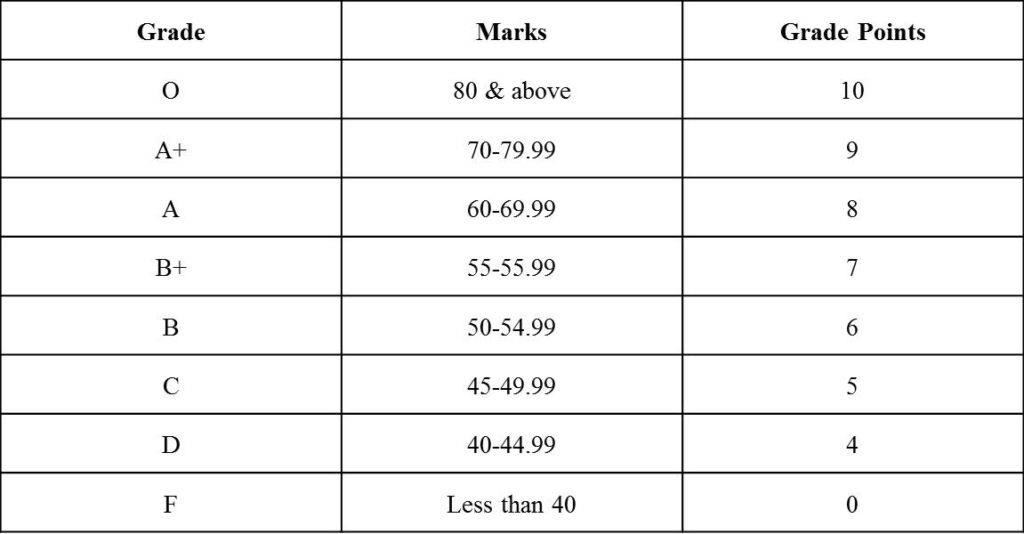
SCHEME OF EXAMINATION
- B.A: The performance of the Learners will be evaluated by one examination of 100 marks at the end of every Semester. (for the Foundation Course subject Internal Assessment component carrying 25% marks and the Semester End Examination component carrying 75% marks will be applicable.)
- B.M.S and B.Com (A&F): The performance of the Learners will be evaluated in two Components. One component will be the Internal Assessment component carrying 25% marks and the second component will be the Semester-wise End Examination component carrying 75% marks.
- BSc (IT): The performance of the Learners will be evaluated in three components. One component will be the Practical examination carrying 50% marks, the second component will be an internal examination of 25% marks and the third component will be the Semester-wise End Examination component carrying 75% marks.
PASSING STANDARD
- For B.A/B.Com: The Learners to pass a course shall have to obtain a minimum of 40% marks in aggregate for each course at the end of every Semester Examination. The learners shall obtain a minimum of 40% marks (i.e 40 marks out of 100) to pass the course and a minimum of Grade D to pass a particular semester. The result of Semester VI shall be kept in abeyance until the student passes each of Semester I, Semester II, Semester III, Semester IV, and Semester V.
- For B.M.S and B.Com (A&F): The Learners to pass a course shall have to obtain a minimum of 40% marks in aggregate for each course where the course consists of Internal Assessment and Semester End Examination. The learners shall obtain a minimum of 40% marks (i.e. 10 out of 25) in the Internal Assessment and 40% marks in Semester End Examination (i.e. 30 out of 75) separately, to pass the course and a minimum of Grade D to pass a particular semester. A learner will be said to have passed the course if the learner passes the Internal Assessment and Semester End Examination together. The result of Semester VI shall be kept in abeyance until the student passes each of Semester I, Semester II, Semester III, Semester IV, and Semester V.
- BSc (IT): A student is said to have passed if he/she secures 40% of marks allotted in each head of passing. Theory of 100 marks and TW/ Practical/Tutorial of 50 marks are treated as separate heads of passing. The student is said to have passed Semester I if the student passes in all heads of the passing of the Semester and is eligible to be admitted to Semester II irrespective of no. of heads of failure in the First Semester. A student is eligible for admission to Semester III if either the student passes Semesters I & II or the student Fails in a combination of Theory and/or Practical taken in Semester I or Semester II or together. Where the total marks do not exceed 200. A student is eligible to be admitted to Semester IV irrespective of no. heads of failure in the Third Semester. However, the student has to clear Semesters I and II to appear for the Semester IV examination. A student is eligible for admission to Semester V if either the student passes Semester III & IV or the student fails in a combination of Theory and/or Practical taken in Semester III or Semester IV or together, where the total marks do not exceed 200. A student is eligible to be admitted to Semester VI irrespective of no. of heads of failure in the fifth Semester. The results of Semester VI should be kept in abeyance until the student clears Semesters III, IV, and V in full.
CARRY FORWARDS OF MARKS IN CASE OF A LEARNER WHO FAILS IN THE SEMESTER-END ASSESSMENT IN ONE OR MORE SUBJECTS:
- A learner who PASSES in the Internal Examination but FAILS in the Semester End Examination of the course shall reappear for the Semester End Examination of that course. However, his / her marks of the internal Examinations shall be carried over and he shall be entitled to the grade obtained by him/her on passing.
- A learner who PASSES in the Semester End Examination but FAILS in the Internal Assessment of the course shall reappear for the Internal Examination of that course. However, his/her marks of the Semester End Examination shall be carried over and he/ she be entitled to the grade obtained by him/her on passing. In the case of a learner who is reappearing for the Internal Examination, the examination will consist of one project of 20 marks which will be divided into 20 marks for the documentation of the project and the presentation and 05 marks for the viva and the interaction.
ALLOWED TO KEEP TERMS (ATKT) : Applicable to the courses under Faculty of BA/ BMS/ B.Com ( A&F ) :
- A learner shall be allowed to keep term for Semester II irrespective of the number of courses of failure in Semester I.
- A learner shall be allowed to keep term for Semester III if he/she passes each of Semester I and Semester II
OR
A learner fails in not more than FOUR courses of Semester I and Semester II taken together with not more than TWO courses at each of Semester I & Semester II.
- A learner shall be allowed to keep term for Semester IV irrespective of the number of courses of failure in Semester III.
- A learner shall be allowed to keep term for Semester V if he/she passes Semester I, Semester II, Semester III and Semester IV
OR
A learner shall have passed Semester I and II in full and secured ATKT in the Second Year by failing in not more than TWO courses in each of Semester III and Semester IV.
OR
A learner shall have secured ATKT in First Year by failing in not more than TWO courses in each of Semester I and Semester II in full.
- A learner shall be allowed to keep term for Semester VI irrespective of the number of courses of failure in Semester V.
- A learner can appear for the Semester VI examination but the result of Semester VI shall be kept in abeyance until the learner passes each of Semester I, Semester II, Semester III, Semester IV and Semester V.
ALLOWED TO KEEP TERMS (ATKT) : Applicable to the course under Faculty of B.Sc.(I.T.) is as follows :
- A student is said to have got ATKT if he/she does not secure 40% of marks allotted in each head of passing.
- Theory of 100 marks and TW/ Practical/Tutorial of 50 marks are treated as separate heads of passing.
- The student is said to have passed Semester I if the student passes in all heads of the passing of the Semester and is eligible to be admitted to Semester II irrespective of no. of heads of failure in the First Semester.
- A student is eligible for admission to Semester III if either the student passes Semesters I & II or the student Fails in a combination of Theory and/or Practical taken in Semester I or Semester II or together. Where the total marks do not exceed 200.
- A student is eligible to be admitted to Semester IV irrespective of no. heads of failure in the Third Semester. However, the student has to clear Semesters I and II to appear for the Semester IV examination.
- A student is eligible for admission to Semester V if either the student passes Semesters III & IV or the student fails in a combination of Theory and/or Practical taken in Semester III or Semester IV or together, where the total marks do not exceed 200
- A student is eligible to be admitted to Semester VI irrespective of no. of heads of
failure in the fifth Semester. The results of Semester VI should be kept in abeyance until the student clears Semesters III, IV and V in full
ADDITIONAL EXAMINATION
ELIGIBILITY NORMS TO APPEAR FOR THE ADDITIONAL SEMESTER END EXAMINATION
A learner who does not appear i.e. remains absent in some or all the courses on medical grounds or for representing the college/university in sports, cultural activities, activities of NSS, NCC or sports training camps conducted by recognized bodies / competent authorities or for any other reason which is considered valid under exceptional circumstances and to the satisfaction of the Principal or the Head of the Institution is eligible to appear for the additional examination.
A learner who does not appear for both the Internal Assessment and Semester End Examination shall not be eligible to appear for the additional Semester End Examination.
The additional Semester End Examination shall be of three hours and 100 marks for B.A Course and 75 marks for BMS, B.Com(A&F), and B.Sc.(I.T.) courses. The learner shall appear for the course of the Semester End Examination for which he/she was absent or failed. Learners who are punished under O.5050 (use of unfair means) are not eligible to appear for this additional examination.
It is not the right of the learner, who has failed or has remained absent, to appear for the additional examination without fulfilling the norms prescribed by the Head of the Institution / Department / Principal of the College.
Mode of Conduct of Semester End Additional Examination :
- There will be one additional examination for Semester I, II, III and IV for those who have failed or remained absent.
- The absent learner will be allowed to appear for the examination by the head of the institution after following the necessary formalities subject to the reasons of the satisfaction of the head of the institution.
- This examination will be held 20 days after the declaration of the result but not later than 40 days.
CODE OF CONDUCT FOR TEACHERS
The college has created a code of conduct for teachers too, which is conveyed to them by their respective Heads of the Department. The teachers are expected to follow the code for themselves thereby creating a positive environment for students as well. There are also certain regulations and control mechanisms for enforcing the code of conduct.
A teacher shall not discriminate against a student on political grounds or for reasons of race, caste, religion, language or sex or other reason of arbitrary or personal nature and shall not incite students/teachers against other teachers, colleagues or administration /Governing body of the College and the University.
A teacher shall have freedom of thought and expression. He/She shall not misuse the facilities or forum of the College/ University.
A teacher shall not refuse to carry out the academic and administrative decisions taken by the Principal/Governing body.
A teacher shall not make use of resources and/or facilities of the Department/College/University/Governing body for personal, commercial, political, or religious purposes.
A teacher shall not be partial in the assessment of a student or deliberately overmark, undermark or victimize a student on any grounds.
A teacher shall not conduct /participate in private coaching classes directly or indirectly. He/She shall not accept private tuitions.
A teacher shall not indulge in, directly or indirectly, any malpractice or unfair means in teaching or examination/ administration.
A teacher shall not furnish incorrect information regarding his qualifications, age, etc. in respect of his appointment/promotion.
Teachers’ behavior and professional conduct must set a good example for all students.
Teachers should avoid using inappropriate or offensive language.
Do not use Social Media such as Facebook and Twitter for inappropriate contact with children, and liking their pages etc. is not permitted. Please keep your own Social Media identity as locked down as possible, so that children at the college cannot find out inappropriate information about you and your family.
The teacher may not use their vehicle to transport students without the college being informed and the correct insurance is in place. Teachers may not engage in an inappropriate relationship with a student as this would be a clear breach of trust. Professional boundaries must be respected and sexual or inappropriate emotional conduct is never acceptable.
During examination duty, teachers should take rounds in the classroom. Mobile phones are not allowed during examination duties.
A teacher should seek to make continuous professional growth through study and research
A teacher should maintain active membership in a professional organization and strive to improve education and profession through them.
A teacher should discourage or not indulge in plagiarism or other unethical behavior in teaching and research.
A teacher should participate in extension, co-curricular and extracurricular activities including community services.
Latest News